
Chicco Corso Flex vs Chicco Corso Primo — Which Is Better?
Side by side |
Chicco
Chicco Corso Flex
—
UNSCORED
|
Chicco
Chicco Corso Primo
—
UNSCORED
|
|---|---|---|
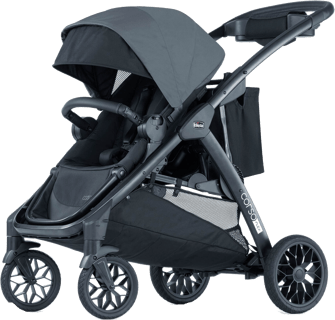 | 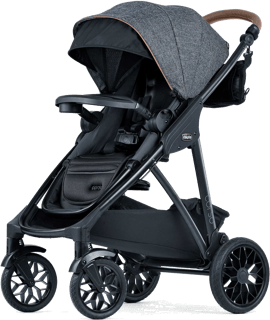 | |
| Scores | ||
| Safety | 87 | — |
| Everyday Use | 100 | 100 |
| General | ||
Read the General ComparisonOverviewThe Corso Flex and Corso Primo are Chicco full-size modular strollers aimed at different households. The Corso Flex is a single-to-double convertible: it ships as a single toddler stroller at 34.5 lb but accepts a second toddler seat or an infant car seat, sold separately, and keeps a built-in youth seat and standing platform on the frame for an older child. The Corso Primo is a single-seat modular stroller, lighter at 26 lb, with a 50 lb maximum weight capacity and a handlebar adjustable across four positions. Everyday use is similar in places: both have a reversible toddler seat, a one-hand fold, and foam-filled tires of the same 8.3 in front and 10.3 in rear diameters. The Primo is the more compact package, folding to 32 in tall with an adjustable handlebar, while the Flex trades compactness for expandable capacity and a wider 26.3 in stance. | ||
| Stroller Status | In Production | In Production |
| Country Origin | China | Unknown |
| Stroller Type | Double/Convertible | Unknown |
| Frame | ||
Read the Frame ComparisonSize & HandlingThe Corso Primo is lighter and more compact in use: 26 lb versus the Flex's 34.5 lb single-toddler setup, and 34.5 in long by 24.8 in wide unfolded against the Flex's 45.5 by 26.3 in footprint. Handlebar fit is the clearest difference. The Flex has a single fixed handlebar position at 42.5 in with no height adjustment, so taller or shorter caregivers get no accommodation. The Primo offers four discrete positions from 39.5 to 44.5 in. Both include a shopping basket; the Flex's Grab-and-Go basket has no stated load limit, and the Primo's basket adds a Zip & Stash section with two bottle pockets. | ||
| Stroller Weight | 15.65 kg2.9537 | 11.79 kg2.9537 |
| Frame Material | Aluminum | Aluminum |
| Unfolded Dimensions | 45.5" L x 26.3" W x 43.0" H | 34.5" L x 24.8" W x 42.8" H |
| Rocking Frame | No | Unknown |
| Maximum Weight Capacity | 18.14 kg9.9899.79 | 22.68 kg9.9899.79 |
| Handle Height Adjustment | No | Yes |
| Handle Material | 100% PVC | 100% PVC |
| Handlebar Height | 42.5 in | 39.5-44.5 in |
| Shopping Basket | Yes | Yes |
| Seat | ||
Read the Seat ComparisonSeating & CapacityCapacity favors the Primo for a single child: its frame is rated to a 50 lb maximum, while the Flex tops out at 40 lb. Recommended age also differs. The Flex's toddler seat is rated from 6 months without an infant car seat, whereas the Primo's seat is rated from birth, so the Primo can carry a newborn in the main seat while the Flex needs its separately sold infant carrier for that stage. The Flex's advantage is expansion: it converts to a double by adding a second toddler seat or infant car seat, each sold separately, and the frame's built-in youth seat and standing platform remain available for an older rider. The Primo stays a one-seat stroller. Both toddler seats are reversible, mounting forward- or parent-facing. Comfort & CareBoth toddler seats cover the comfort basics: a canopy with a peek-a-boo panel, a multi-position reclining backrest, an adjustable footrest with positionable leg support, and removable, machine-washable fabrics. The Flex seat pad comes out for machine washing with spot cleaning for the rest; the Primo's main seat fabric unzips from the frame and washes cold on a delicate cycle with drip drying. The Flex canopy adds a pull-out extension, and its UPF 50+ rating applies to the main toddler-seat canopy specifically. Recline operation differs in detail: the Primo uses a rear-located, lever-operated recline mechanism, while no comparable adjustment method is established for the Flex. Neither seat's recline is documented as fully flat, and no exact recline angles or position counts are stated for either. Harness & RestraintsRestraint systems are closely matched. Both toddler seats use a 5-point harness with three shoulder-strap height positions to grow with the child, and both include a bumper bar. On the Flex, note that the 3-point harness belongs to the built-in youth seat, not the main modular seat. The Primo adds a removable crotch strap pad. | ||
| Seats Number | Unknown | 1 |
| Double Type |  Tandem | – |
| Recommended Age | 6 months + | 0 months + |
| Converts Double | Yes | No |
| Reversible Unit | Yes | Yes |
| Bassinet | No | Unknown |
| Safety Harness | 5-point | 5-point |
| Safety Harness Padding | Yes | Yes |
| Height Adjustable Harness | Yes | Yes |
| Ventilation Integrated | Unknown | Unknown |
| Canopy | Yes | Yes |
| Waterproof Canopy | Yes | Unknown |
| Peek A Boo Window | Yes | Yes |
| Bumper Bar | Yes | Yes |
| Reclining Backrest | Yes | Yes |
| Full Reclining Backrest | Yes | Yes |
| Backrest Type | Unknown | Rear lever |
| Footrest | Yes | Yes |
| Legrest Position | Yes | Yes |
| Fabrics Removable | Yes | Yes |
| Fabrics Cleaning | Machine washable, Wipe-clean / Spot-clean | Machine washable |
| Folding and Traveling | ||
Read the Folding and Traveling ComparisonFolding & TravelBoth strollers fold with one hand and fold with the toddler seat forward-facing. The Primo folds to 15.5 in long by 24.8 in wide by 32 in tall, a concrete number for trunk planning; no comparable folded dimensions are established for the Flex, which instead carries a fold-and-go carry handle for lifting the folded package. | ||
| Folding System |  Compact flat fold | Compact flat fold |
| Folds Forward Facing Seat | Yes | Yes |
| Auto Locking Fold | Yes | Yes |
| Carry Strap | Yes | Unknown |
| One Hand Fold | Yes | Yes |
| Airplane Carry On | Unknown | No |
| Folded Dimensions | — | 201.57 L10.681,482 |
| Car-Seat | ||
Read the Car-Seat ComparisonInfant Car SeatsBoth strollers take an infant car seat sold separately; a carrier is not bundled with either. The Flex accepts all Chicco infant car seats using its included adapter; compatibility with other carrier brands is not stated. The Primo's adapter is also included, so adapter inclusion should not be mistaken for a bundled carrier on either model. | ||
| Car Seat Compatible | Yes | Yes |
| Car Seat Sold Separately | Yes | Yes |
| Maxi Cybex Adaptors | No | No |
| Britax Car Seat Adapters | No | No |
| Wheels | ||
Read the Wheels ComparisonWheels & TerrainThe rolling gear is essentially shared: both use foam-filled tires front and rear, in the same 8.3 in front and 10.3 in rear diameters, with front wheels that swivel or lock fixed. Wheels are removable on both, by release buttons on the Primo's front wheels and per the Flex manual's front and rear removal steps. Suspension differs in scope: the Flex is documented with all-wheel suspension, while the Primo's evidence establishes suspension without specifying which wheels. Brakes differ in detail: the Flex uses a foot brake, and the Primo uses push-down-to-lock, pull-up-to-unlock levers on each side of the rear assembly. | ||
| Number Wheels | 4 | 4 |
| Front Wheels Type | Foam-filled tires | Foam-filled tires |
| Rear Wheels Type | Foam-filled tires | Foam-filled tires |
| Front Diameter | 8.3 in | 8.3" |
| Rear Diameter | 10.3 in | 10.3" |
| All Terrain Stroller | No | Unknown |
| Brake System | Foot brake | Push Down - Lift Up Pedal |
| Lockable Wheels | Yes | Yes |
| Removable Wheels | Yes | Yes |
| Suspension Wheels | All | Yes |
Read the Verdict
Verdict
Choose the Corso Flex if a second child is on the horizon or an older sibling already rides: its convertible frame, built-in youth seat and standing platform, and second-seat option cover growth the Primo cannot, at the cost of a heavier 34.5 lb single setup, a wider stance, and a fixed 42.5 in handlebar. Choose the Corso Primo for a single child: it is lighter at 26 lb, rated from birth in the main seat, holds to a 50 lb maximum, folds to a compact 32 in height, and fits caregivers across a 39.5 to 44.5 in handlebar range.